
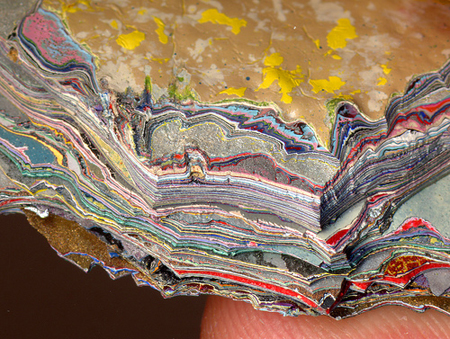
Philosophers and neuroscientists have debated the essence of aesthetics from many angles—its evolutionary origins and psychological framework being two of the more popular. Yet there is one common tie among all productions that are pleasing to the senses that is most crucial to understanding why we enjoy them. Every exceptional creative work, be it fine art or part of pop culture, relies on a fundamental concept for its success: layers.
Layers are the fabric (literally, sometimes) of creativity. A painter uses layers of paint to build rich color and texture on a canvas. A graphic designer uses layers to add dimension and dynamism to a flat surface. A writer uses layers to construct a rich and compelling passage of text. A sound mixer uses layers to develop a melody that is strikingly new and catchy at the same time. A film editor uses layers to combine sounds and visuals in an emotionally-arresting way. And fashion designers use layers to create eyecatching ensembles, one color and texture at a time.
Complexity gives the mind something it can’t dismiss with a glance. When a work of art, an outfit, or a beat is too simple, it is easily ignored. But start adding levels of meaning or physical depth, and the piece becomes something to be studied. The best creative pieces can be enjoyed on multiple levels—appreciated by a novice and pored over by an expert. In short, layers make life interesting.
Keep reading...
Thursday, October 8, 2009
The Crux of Creativity


Monday, October 5, 2009
The Retail Brain Drain

Several years ago a list was circulated online, mostly through the Facebook grapevine, that enumerated the experiences and cultural hallmarks shared by American kids growing up in the ‘90s. From Captain Planet to slap bracelets, the list was quite thorough. There was, however, one unfortunate omission: the educational toy store.
The mid-‘90s were the heyday of the educational toy store—fantastic houses of knowledge like Learningsmith, Zany Brainy, and The Nature Company. Selling all manner of intriguing objects and playthings, each one presented a welcoming environment to while away an hour or an afternoon, exploring the store and, by extension, the world.
Existing for the most part in the pre-internet age, these stores thrived by captivating the imagination of children (and, to be sure, their parents as well). The Nature Company offered drawers of fascinating fossils and rocks, Learningsmith stocked an ever-changing variety of irresistible games and puzzles, and Zany Brainy had dozens of toys available to try out for free. Each was a paragon of merging children’s interests with their parents, and a paradise of educational fun. Kids came on weekends to check out the newest Lego sets, magnetic wonders, and colorful board games, and parents could take comfort in the fact that these diversions were beneficial to their children's intellectual devleopment.
But times have changed. Technology has triumphed over toys, though not exclusively to the detriment of today’s youth. Information is accessible as never before, making memorization of facts largely obsolete. And while it seems sane to mourn the loss of real, in-mind knowledge, the way we interact with information 50 years from now may make this headshaking and in-my-daying seem shortsighted. As more and more information is digitally indexed, and consequently made easier to search, analyze, and cross-reference, less value will be placed upon an individual’s ability to summon facts from memory, and more emphasis placed upon his capacity to synthesize concepts and draw inferences from them.
Keep reading...
Monday, September 21, 2009
Punctuation Perplexity

How to punctuate interpersonal communication is a perpetual quandary for me. Though our alphabet offers quite a few marvelous marks (my favorite being the em dash), they tend to fall short in many common everyday situations.
Take courtship. When writing to a prospective paramour, one must pay attention to the smallest details. Not only the words, but also the punctuation marks between them, contribute to the substance of the overall message. For example, say you want to tell someone how great it was to meet them last night. Should you write:
It was great to meet you last night.
or
It was great to meet you last night!
The first sounds sterile and nonchalant, while the second comes across as overly enthusiastic and aggressive. Since the advent of the digital age, however, people have taken to creating new symbols (emoticons) to fill the semantic gaps. So we have a third option:
It was great to meet you last night : )
This smiley communicates the necessary flirtatiousness, without being too over-the-top. Professional emails may also be subject to this tonal ambiguity.
Thanks for taking the time to speak with me yesterday.
Thanks for taking the time to speak with me yesterday!
While the first sounds objective and slightly sterile, the second may come across as unctuous. After agonizing over this decision many times, I finally came up with a solution: the ellipsis.
Thanks for taking the time to speak with me yesterday...I hope to hear back from you soon!
In this case, the exclamation point feels less forced, since it is now emphasizing two points, connected by those three helpful dots. An ellipsis comes in handy in all kinds of situations, and has become my go-to punctuation when none others seem to do. In fact, I recently met someone whose ellipsis-affinity is even stronger than mine. All of his text messages use ellipses as substitutes or add-ons for other punctuation marks (On way... Good deal...K... OMG....!!! Really...???). As an ellipsis lover, I felt true kinship with this person.
There are many marks that are rarely seen, but fill in important gaps in the usual punctuation bank. The interrobang (‽), for example, combines a question mark and exclamation point, and would likely be used extensively were it included on keyboards. Personally, I've always found there to be an excess of symmetric enclosures--{}[]()<> on keyboards, some of which could surely be relegated to the "symbols" box for their occasional use, freeing up valuable keyboard space.
As language continues to evolve, people will surely find new uses for existing marks and perhaps create new ones. In fact, the first mark used to separate sentences was the interpunct ( · ), common in Ancient Latin texts. Who knows what linguistic transformations will take place over the coming years to affect punctuation. (Should I end that with a period or a question mark? Hmmmmm...)
Keep reading...
Sunday, July 12, 2009
Really?
To be sure, the internet is filled with countless headscratching headlines and pictures, documented diligently by the billions of eyes and ears that inhabit the web on a daily basis.
Here are two tidbits I've found the past couple days, both of which had me shaking my head in amazement. 
The first is the bottom headline on Yahoo's news feed. There are certain Paris Hilton news items that could conceivably qualify as news. She gets married, has a baby, or dies. That's about it. Waving at a judge? Is that really one of the five most important news stories at 7:33pm EST? I highly doubt it. 
The second is from a Microsoft help page about a missing codec. It offers a helpful suggestion, saying the codec I need may be available to download from the Internet! Really? That's fantastic! I just go to the Internet and get my codec? Do I need to use AOL to do this or will Altavista work? Thanks, Microsoft!
Keep reading...
Tuesday, June 16, 2009
Babies Are Funny
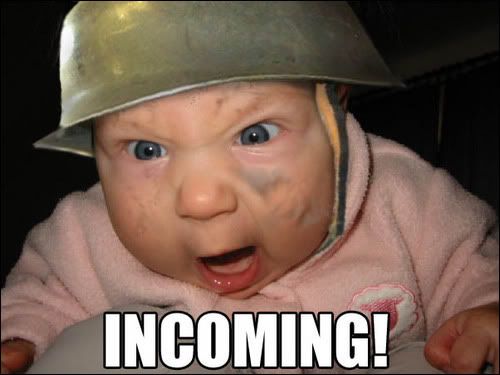
We are in a Golden Age of baby-based humor. The mere appearance of baby is enough to elicit a smile from all but the most cold-hearted of adults, so put a baby on screen and you’re halfway to a laugh. Babies are wide-eyed innocents, perfect patsies for our childish pranks and perversions.
Perhaps the epitome of the current enthusiasm for exploiting infants for laughs can be found in The Hangover, the number one movie at the box office for two weeks running.
Although I generally found the movie unfunny and unimaginative, the scene in which Zach Galafianakis manipulates the baby’s arm to suggest a certain private male act had me cracking up even after leaving the theater. This juxtaposition of complete innocence and crude vulgarity is a recipe for comedy gold.
For a more toned down version of this, refer to the famous “E-Trade Baby” commercials, which first aired during the Super Bowl. Few commercials are as widely liked as those featuring this savvy toddler, with the slurred, nasal voice of a 30-something hipster. Again, combining the baby’s natural movements and expressions with sharp, sophisticated dialogue ¬has very humorous results.
But this is just the tip of the iceberg. Beyond Hollywood and Madison Avenue, on the unlimited expanses of the internet, one finds countless examples of cute babies turned into comedic showpieces. The #4 most-viewed video ever on You-Tube is Charlie Bit My Finger, featuring two brothers, one of whom, you guessed it, bites the other. There are also several popular videos of babies laughing. Hahaha is #11 all-time, and The Evil Look and its many copies have tens of millions of views. Another, “Blood,” shows a concerned toddler pointing out blood to his parents, and growing increasingly frustrated with their unexpected reaction.
Anther popular internet meme is the Funny Photoshopped Baby Face, which is simple a picture of an evil-looking baby who has been digitally given all sorts of costumes, from Hitler to Shrek.
Parents have always been entertained by their adorable offspring, but it is only recently they have gotten the chance to share these moments with the world. As long as they remain cute and helpless, babies will continue to be playthings for grown-ups. I only hope that people do not abuse their power, but allow society’s only unadulterated members to enjoy their precious pre-conscious years in peace.
Keep reading...


