

English is beloved by language lovers everywhere for its lexical richness, a result of its heritage as an amalgam of both Romance and Germanic words. It may not have the elan of French or the gusto of Italian, but no language compares to English in terms of the depth of its vocabulary.
Like other Indo-European languages, English relies on a large supply of prefixes, suffixes, and other units of speech to convey meaning. Most suffixes are quite flexible, and are used by English speakers to coin new words (think Kafkaesque, doable). This makes English almost infinitely expandable, and enables anyone to contribute neologisms to the lexicon.
My topic of discussion today is one suffix in particular: "-oon."
Oon may be my favorite suffix, as its appendage makes any word instantly more fun. What's more exciting, a bar or a saloon? Who would you rather meet, a magnate or a tycoon? Which is a better insult, idiot or buffoon? (The list goes on--bass vs. bassoon, storm/monsoon, etc.) And who doesn't like cartoons?
Oon words are fun on the tongue (or, more precisely, the lips) and also fun to write. I remember the first time I learned about the people known as Walloons who live on the border of Belgium and France. What a fantastic name, I thought! I think I imagined Walloons as jolly, playful people, possibly combining the concepts of "walrus" and "balloon" in my head.
Today my enjoyment of the suffix is no less, and I look forward to English adding more oony words in the years to come.
Keep reading...
Monday, November 16, 2009
Soon The Moon Will Rise at Noon


Saturday, November 14, 2009
How to Solve America's Obesity Problem

Simple: Ban free bottomless tortilla chips at Mexican restaurants.
I'm only half kidding. Those chips--always the same fried yellow triangles, whether you're in Atlanta or Olympia--are the single biggest threat to American diets today. In the kitchens of "Mexican" restaurants across the country, tortilla chips are stored in huge trash cans (seriously), and dispatched in heaping piles to new tables as soon as they're seated. Before water or waiter, there is a mound of crispy, greasy, addictive chips begging to be devoured. These chips contain hundreds of calories and plenty of stealth fat, all consumed before even touching the meal one has paid for.
No matter what size the party is, the portion is the same. That means a table of two will share the equivalent of over half a bag of store-bought chips, except the ones they serve in a restaurant are even less nutritious. Many grocery store chips these days have added whole grains and fiber, and may even be baked. Restaurant chips, however, are merely fried corn pulp, produced in massive quantities by factories probably working around the clock to sate our appetite for endless chips.
America was the first, and may remain the only, country to "enjoy" this perk in its Mexican establishments. Do real Mexicans nomnomnom on infinite chips with every meal? Of course not! They're too busy eating delicious tacos, flautas, gorditas, and other incredible authentic dishes to bother with silly chips. Other restaurants that offer complimentary preprandial snacks typically provide a basket of bread slices, and perhaps some pats of butter. This is a much more effective and healthy choice, as it satisfies the pre-meal borborygmus (my apologies for the two 50-cent words--I owe you a dollar) without being dangerously addictive.
Some governments--most notably that of New York City--have attempted to curb obesity by requiring restaurants to post calorie counts for the items on their menu. This has proven surprisingly ineffective, as pointed out in a recent Op-Ed in the New York Times. If people cannot be counted on to eat their tortilla chips with discipline, a limit should be imposed. Something akin to lashing Odysseus to the mast of his ship--a voluntary restriction of chip intake via some sort of emergency button to prevent continuous refills.
Obesity is probably the most serious and costly health issue facing America today. Many fatal diseases--too many to list--have been tied to this relatively preventable condition. So let's all agree to take an easy step towards dietary health, and say adios to the bottomless chip basket.
Keep reading...
Thursday, October 8, 2009
The Crux of Creativity
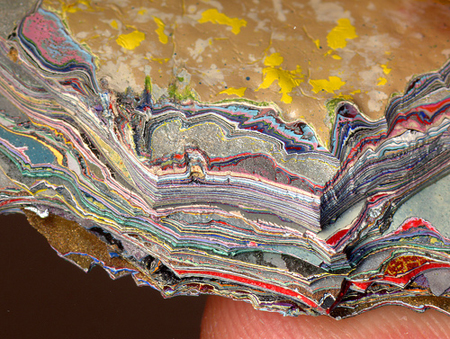
Philosophers and neuroscientists have debated the essence of aesthetics from many angles—its evolutionary origins and psychological framework being two of the more popular. Yet there is one common tie among all productions that are pleasing to the senses that is most crucial to understanding why we enjoy them. Every exceptional creative work, be it fine art or part of pop culture, relies on a fundamental concept for its success: layers.
Layers are the fabric (literally, sometimes) of creativity. A painter uses layers of paint to build rich color and texture on a canvas. A graphic designer uses layers to add dimension and dynamism to a flat surface. A writer uses layers to construct a rich and compelling passage of text. A sound mixer uses layers to develop a melody that is strikingly new and catchy at the same time. A film editor uses layers to combine sounds and visuals in an emotionally-arresting way. And fashion designers use layers to create eyecatching ensembles, one color and texture at a time.
Complexity gives the mind something it can’t dismiss with a glance. When a work of art, an outfit, or a beat is too simple, it is easily ignored. But start adding levels of meaning or physical depth, and the piece becomes something to be studied. The best creative pieces can be enjoyed on multiple levels—appreciated by a novice and pored over by an expert. In short, layers make life interesting.
Keep reading...
Monday, October 5, 2009
The Retail Brain Drain

Several years ago a list was circulated online, mostly through the Facebook grapevine, that enumerated the experiences and cultural hallmarks shared by American kids growing up in the ‘90s. From Captain Planet to slap bracelets, the list was quite thorough. There was, however, one unfortunate omission: the educational toy store.
The mid-‘90s were the heyday of the educational toy store—fantastic houses of knowledge like Learningsmith, Zany Brainy, and The Nature Company. Selling all manner of intriguing objects and playthings, each one presented a welcoming environment to while away an hour or an afternoon, exploring the store and, by extension, the world.
Existing for the most part in the pre-internet age, these stores thrived by captivating the imagination of children (and, to be sure, their parents as well). The Nature Company offered drawers of fascinating fossils and rocks, Learningsmith stocked an ever-changing variety of irresistible games and puzzles, and Zany Brainy had dozens of toys available to try out for free. Each was a paragon of merging children’s interests with their parents, and a paradise of educational fun. Kids came on weekends to check out the newest Lego sets, magnetic wonders, and colorful board games, and parents could take comfort in the fact that these diversions were beneficial to their children's intellectual devleopment.
But times have changed. Technology has triumphed over toys, though not exclusively to the detriment of today’s youth. Information is accessible as never before, making memorization of facts largely obsolete. And while it seems sane to mourn the loss of real, in-mind knowledge, the way we interact with information 50 years from now may make this headshaking and in-my-daying seem shortsighted. As more and more information is digitally indexed, and consequently made easier to search, analyze, and cross-reference, less value will be placed upon an individual’s ability to summon facts from memory, and more emphasis placed upon his capacity to synthesize concepts and draw inferences from them.
Keep reading...
Monday, September 21, 2009
Punctuation Perplexity

How to punctuate interpersonal communication is a perpetual quandary for me. Though our alphabet offers quite a few marvelous marks (my favorite being the em dash), they tend to fall short in many common everyday situations.
Take courtship. When writing to a prospective paramour, one must pay attention to the smallest details. Not only the words, but also the punctuation marks between them, contribute to the substance of the overall message. For example, say you want to tell someone how great it was to meet them last night. Should you write:
It was great to meet you last night.
or
It was great to meet you last night!
The first sounds sterile and nonchalant, while the second comes across as overly enthusiastic and aggressive. Since the advent of the digital age, however, people have taken to creating new symbols (emoticons) to fill the semantic gaps. So we have a third option:
It was great to meet you last night : )
This smiley communicates the necessary flirtatiousness, without being too over-the-top. Professional emails may also be subject to this tonal ambiguity.
Thanks for taking the time to speak with me yesterday.
Thanks for taking the time to speak with me yesterday!
While the first sounds objective and slightly sterile, the second may come across as unctuous. After agonizing over this decision many times, I finally came up with a solution: the ellipsis.
Thanks for taking the time to speak with me yesterday...I hope to hear back from you soon!
In this case, the exclamation point feels less forced, since it is now emphasizing two points, connected by those three helpful dots. An ellipsis comes in handy in all kinds of situations, and has become my go-to punctuation when none others seem to do. In fact, I recently met someone whose ellipsis-affinity is even stronger than mine. All of his text messages use ellipses as substitutes or add-ons for other punctuation marks (On way... Good deal...K... OMG....!!! Really...???). As an ellipsis lover, I felt true kinship with this person.
There are many marks that are rarely seen, but fill in important gaps in the usual punctuation bank. The interrobang (‽), for example, combines a question mark and exclamation point, and would likely be used extensively were it included on keyboards. Personally, I've always found there to be an excess of symmetric enclosures--{}[]()<> on keyboards, some of which could surely be relegated to the "symbols" box for their occasional use, freeing up valuable keyboard space.
As language continues to evolve, people will surely find new uses for existing marks and perhaps create new ones. In fact, the first mark used to separate sentences was the interpunct ( · ), common in Ancient Latin texts. Who knows what linguistic transformations will take place over the coming years to affect punctuation. (Should I end that with a period or a question mark? Hmmmmm...)
Keep reading...


